

Maqam Ibrahim is a name that is known as soon as the word Umrah is said. This structure is found near the Kaaba, the great cube-shaped building in the middle of the Masjid al Haram in Makkah. It is of immense significance in Islam, and the story stretches back to the very beginning of the Kaaba itself. We explain a little of the history and importance of Maqam Ibrahim in this guide with some helpful recommendations for UK pilgrims.
What Is Maqam Ibrahim?
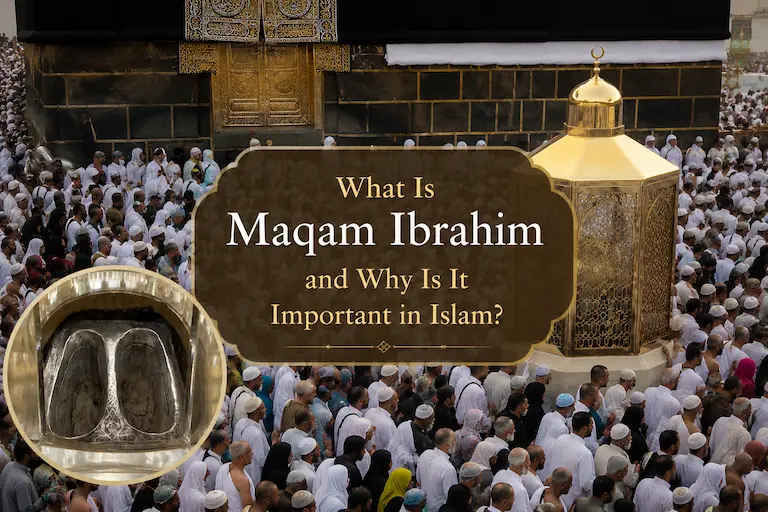
Maqam Ibrahim is translated as the Station of Ibrahim. A small stone is kept inside this structure, and it is believed to carry the footprints of Prophet Ibrahim (peace be upon him). The stone is placed inside a glass case, and a gold coloured frame has been built around it for protection.
This small structure is positioned only a short distance from the Kaaba, near the door of the Kaaba. During Tawaf, when the Kaaba is walked around seven times, Maqam Ibrahim is passed by every pilgrim. Although it is small in size, a big story from Islamic history is connected to this one spot.
Maqam Ibrahim History
The Story Behind the Footprint
The history of Maqam Ibrahim is closely linked to the building of the Kaaba. According to Islamic belief, the Kaaba was erected by Prophet Ibrahim (peace be upon him) and his son Prophet Ismail.
As the walls of the Kaaba grew taller, a problem was faced by Ibrahim, since the top could no longer be reached easily. A stone was brought and placed under his feet, so the building work could continue. It is believed that, because of this, his footprints were left in the stone, almost as if it were soft clay under his feet.
The Quran and Maqam Ibrahim
This event is also connected to a verse in the Quran. In Surah Al Baqarah, a chapter of the Quran, believers are told to take the standing place of Ibrahim as a place of prayer. Because of this verse, Maqam Ibrahim has been treated as a sacred spot for many centuries.
In the early years of Islam, the stone was kept very close to the wall of the Kaaba. Later, during the time of Umar ibn Al Khattab, the second Caliph (an early leader of the Muslim community), the stone was moved a short distance away. This was done so more space could be given to pilgrims performing Tawaf. The same spot is where Maqam Ibrahim can still be found today.
What Is Inside Maqam Ibrahim?
A question often asked by pilgrims is, What is inside Maqam Ibrahim? Inside the gold dome, a single stone is kept, and two footprint marks are said to be pressed into its surface.
For safety reasons, this stone can no longer be touched or seen up close. It is fully covered by a glass case, with a metal frame placed around it for extra protection. This step is needed since this small area is visited by millions of pilgrims every year.
Even though the stone itself cannot be viewed directly, its exact spot is clearly marked. Because of this, it can easily be found by pilgrims during Tawaf and during prayer afterwards.
The Footprint Maqam-e-Ibrahim
The footprint Maqam-e-Ibrahim is one of the most talked about parts of this whole site. By many pilgrims, this footprint is seen as a powerful reminder of trust, patience, and hard work.
According to tradition, the Kaaba was built using simple tools and strong faith. The footprint left in the stone is treated as a symbol of this effort, even though it cannot be seen directly by visitors today.
This story is shared with many pilgrims by guides during Umrah and Hajj, and the spot itself is treated with great respect by everyone who walks past it.
Why Is Maqam Ibrahim Important in Islam?
A few simple reasons can help explain why Maqam Ibrahim is seen as important in Islam.
First, a strong connection is held with Prophet Ibrahim, who is respected as a father figure of faith in Islam, Christianity, and Judaism. His story of trust in Allah is repeated many times throughout the Quran.
Second, a clear link is formed with the building of the Kaaba, the most sacred site in Islam. The Kaaba is faced by Muslims during every prayer, no matter where they are in the world.
Third, a small but special role is played by Maqam Ibrahim during Tawaf. Once Tawaf has been completed, prayer near Maqam Ibrahim is encouraged, following the example set by Prophet Muhammad (peace be upon him).
Dua at Maqam Ibrahim
Once Tawaf has been completed, Maqam Ibrahim is usually approached by pilgrims. Here, two short units of prayer, known as rak’ahs, are offered, if enough space is available.
There is no single fixed dua at Maqam Ibrahim that must be recited. Instead, the short prayer itself is treated as an act of worship and thanks. After this prayer, personal dua can be made, in the pilgrim’s own words, asking Allah for anything that is needed.
If the area near Maqam Ibrahim feels too crowded, prayer can be offered in another part of the mosque instead. The reward for this prayer is not lost because of crowding. Comfort and safety should always be placed first.
Maqam Ibrahim During Umrah and Hajj
For pilgrims performing Umrah or Hajj (the main yearly pilgrimage), a simple order is usually followed after Tawaf:
- Tawaf is completed first, with seven rounds walked around the Kaaba.
- Maqam Ibrahim is then approached.
- Two rak’ahs are performed at this site, or in the next open space if it is crowded.
- Personal dua is made once the prayer has been finished.
- The Zamzam well, known for its blessed water, is then visited, as it is found close by.
This simple order can help new pilgrims feel more prepared. So less confusion is felt once the Grand Mosque is reached for the first time.
Tips for UK Pilgrims Visiting Maqam Ibrahim
A few simple tips can be followed by pilgrims travelling from the UK to make this part of the trip feel easier.
Best Time to Visit
Heavier crowds are usually seen during Ramadan and the Hajj season. If a quieter visit is preferred, other months of the year can be considered instead. Early mornings are also a good time, as smaller crowds are often found near Maqam Ibrahim at this time of day.
Umrah Visa for UK Travellers
A valid Umrah visa is needed by UK travellers before entry into Saudi Arabia is allowed. In most cases, this visa is applied for online, or it is arranged by the travel agency as part of an Umrah package. Because visa rules can change from time to time, it is always worth checking the latest requirements with a trusted Umrah travel agency before a trip is booked.
What to Pack
Comfortable shoes are recommended, as a lot of walking is involved during Tawaf and around the wider mosque area. A small bag for personal things is also good. A bottle for Zamzam water, which is typically given out at the prayer place.
Selecting the Right Accommodation
Why Location Matters
Accommodation is a key factor in how comfortable an Umrah trip feels. Hotels near the Grand Mosque are often more popular. You’ll have to walk less to go to the Kaaba and Maqam Ibrahim. This is particularly useful for elder pilgrims, or for those travelling with little children.
What’s Included in Umrah Packages UK
Umrah packages UK usually include flights, visa support, transport and hotel stays. This can make planning much simpler, especially for pilgrims who are travelling for the first time.
At Alhadi Travel, accommodation close to the Haram is included as part of well planned Umrah packages UK. So, pilgrims can focus more on prayer and worship, and less on logistics. When accommodation is being chosen, distance to the mosque, room comfort, and whether transport is included should all be thought about carefully.
Final Thoughts
Maqam Ibrahim may be small in size, but a huge story is carried by it. A clear connection is made to Prophet Ibrahim, to the building of the Kaaba, and to centuries of worship carried out by millions of Muslims.
If you get to know about Maqam Ibrahim, before your Umrah voyage, you might add more meaning to your Umrah journey. Every step during Tawaf, every prayer uttered around this place is a part of a story that goes back to the very beginning of the Kaaba.
With proper planning, the backing of a reliable Umrah travel operator and a calm, patient disposition, a visit to Maqam Ibrahim can be one of the most vital parts of the entire journey.