

Introduction
Every year millions of Muslims from all over the world come to do Hajj and Umrah. The performance of Tawaf is one of the most essential of all the rites performed throughout these holy pilgrimages.
It happens inside the Grand Mosque in Makkah, Saudi Arabia and is seen by the pilgrims from all corners of the globe. Knowing what Tawaf is before coming in the holy city makes for a more meaningful and focused experience for people travelling from the UK.
In this article, we’ll explain what Tawaf is, what is involved in the Tawaf meaning, why it needs to be done and all UK pilgrims need to know before performing it.
What Is Tawaf? A Clear and Simple Explanation
So, what is the Tawaf? Simply put, Tawaf is the act of walking around the Kaaba seven times in an anticlockwise fashion. The Kaaba is the massive cube-shaped building at the core of Masjid al-Haram, the Grand Mosque in Makkah. It is the most sacred location in Islam.
Tawaf is an Arabic term which means “to go around” or “to circle” and is derived from the Arabic language. It is used, particularly in the context of Hajj and Umrah, to mean the act of circling the Kaaba as an act of worship.
Tawaf is not a small affair. It has a definite structure. It starts at a certain time, has a certain number of rounds and is accompanied with supplications and remembrance of Allah all through.
The Tawaf Meaning: More Than a Physical Walk
The Tawaf meaning extends considerably deeper than the physical movement of walking or Each round around the Kaaba is a demonstration of love, submission, and devotion to Allah. It is a manner of indicating that all of a pilgrim’s emphasis, in that moment, is concentrated on Allah alone.
Islamic scholars say the angels in heaven similarly perform an act of adoration by circling the Divine Throne. And a muslim in Tawaf is participating in a worship that is said to be the equivalent of this worship in heaven.
Tawaf also holds a deep feeling of recollection. As pilgrims walk, they remember that the Kaaba has been a place of prayer since the time of Prophet Ibrahim (Abraham). It is a link to a faith history in the making for thousands of years.
A Visible Symbol of Muslim Unity
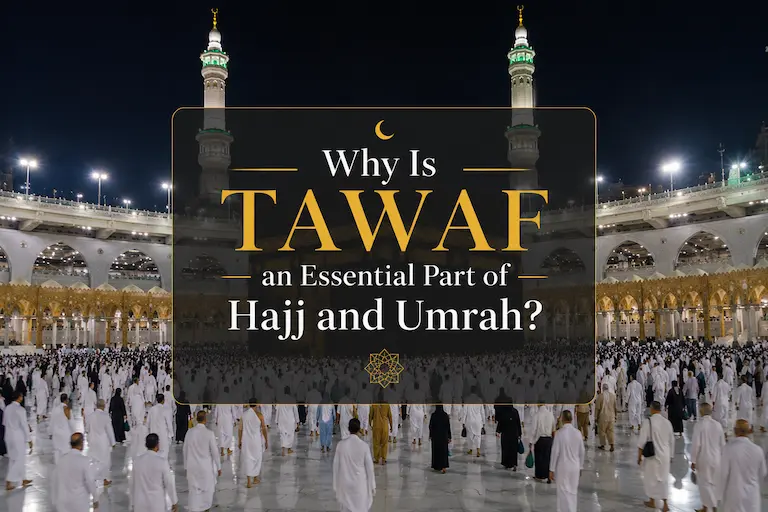
One of the most striking aspects of Tawaf is what is seen during the walk. Pilgrims from Pakistan, the UK, Nigeria, Indonesia, Turkey, and dozens of other countries are all dressed in similar simple white garments and moving in the same direction around the same house of worship.
No one person is placed higher than another. There are no separate queues based on wealth or background. Everyone walks the same path. This shared act of circling the Kaaba is one of the most powerful expressions of unity that exists in the Muslim world.
Why Tawaf Is Required in Hajj and Umrah
Tawaf is not optional. It is one of the core requirements of both Hajj and Umrah. Without it, neither pilgrimage is considered valid.
In Umrah, which is the shorter pilgrimage performed throughout the year by Muslims from the UK and beyond, Tawaf sits at the very centre of the ritual. The three main steps of Umrah are:
- Entering the state of Ihram, which is a state of spiritual purity and intention
- Performing Tawaf around the Kaaba
- Performing Sa’i, which involves walking seven times between the hills of Safa and Marwa
Islamic scholars classify Tawaf in Umrah as a Rukn, meaning a pillar or foundational act. It cannot be skipped, replaced, or made up for with a sacrifice and If it is missed, the Umrah is incomplete.
In Hajj, Tawaf is performed multiple times across the days of the pilgrimage, making it one of the most repeated acts of worship throughout the entire journey.
The Different Types of Tawaf in Hajj
During Hajj, different types of Tawaf are performed, each with its own significance:
Tawaf al-Qudum is the arrival Tawaf. It is performed when a pilgrim first enters Makkah. It is a greeting to the House of Allah and a way of marking the beginning of the pilgrimage.
Tawaf al-Ifadah is the most important Tawaf in Hajj. It is performed after the standing at Arafat on the ninth day of Dhul Hijjah. This Tawaf is one of the essential pillars of Hajj and must be completed.
Tawaf al-Wada is the farewell Tawaf. It is performed just before leaving Makkah. For pilgrims, it is the final act of worship at the Kaaba before returning home.
The Tawaf of the Umrah pilgrim is comparable to Tawaf al-Ifadah in rules and value.
How Tawaf Is Performed: A Step-by-Step Overview
By knowing how Tawaf is done, pilgrims feel ready before they come.
Starting at the Black Stone
It is started from the Black Stone which is called in Arabic Al-Hajar al Aswad. This stone is embedded in the eastern corner of the Kaaba, and at the start of each circuit, the Black Stone is faced. If it is possible to kiss it, that is the Sunnah, the practice of the Prophet Muhammad (peace be upon him). If the crowd is too large, which is common during peak seasons, the Black Stone is simply pointed towards from a distance while saying “Bismillah, Allahu Akbar” (In the name of Allah, Allah is the Greatest).
Completing Seven Rounds
From the Black Stone, the pilgrim walks around the Kaaba in an anti-clockwise direction. The Kaaba remains to the left throughout. Each complete circuit that begins and ends at the Black Stone counts as one round.
Two units of prayer are held near Maqam Ibrahim, the station of Prophet Ibrahim after seven circles. After this prayer, attendees drink from the water of Zamzam, a holy well in the mosque.
Practical Tips for UK Pilgrims Performing Tawaf
If you’re travelling from the UK there are a few practical things it’s worth understanding before you go:
Wear comfy shoes. Shoes are taken off before entering the mosque, or walking around the Kaaba is a fair distance.
Choose quieter times. Tawaf performed late at night or in the early morning hours is often less crowded. This allows for a more peaceful and focused experience.
Stay hydrated. The area around the Kaaba is partially open-air, and temperatures in Makkah are high for much of the year. Zamzam water is freely available throughout the mosque.
Plan for assistance. For elderly pilgrims or those with limited mobility, wheelchair Tawaf is available on the upper floors of the mosque. Arrangements for this should be made in advance through your travel provider.
Alhadi Travel provides travellers with complete guidance on how to do Tawaf and all other rites before leaving as part of their Hajj and Umrah packages. There is special support for new pilgrims to make sure they are confident and prepared on their pilgrimage.
Choosing the Right Accommodation for Tawaf
The hotel in Makkah directly influences your ability to complete Tawaf easily. Hotels near the Grand Mosque are close enough to make it easy for pilgrims to walk to the Kaaba, and to do extra Tawaf in their stay than the needed circuits.
Many Umrah pilgrims have told us that proximity to the mosque enabled them to do Tawaf multiple times throughout their visit, not just as a religious obligation, but also as a personal act of worship anytime they wished.
Alhadi Travel provides numerous hotel alternatives in varied distances from Masjid al-Haram to suit different budgets and group sizes. Accommodation is arranged considering the pilgrim’s comfort and access to the mosque from 3-star to 5-star hotels.